|
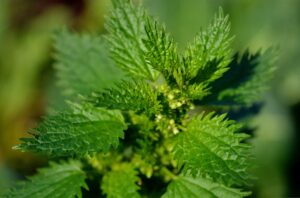
It is said that in nature, within three feet of a poison is the cure. How amazing is it that a stinging plant, carrying histamines, when taken as a tea, acts as a natural antihistamine– easing seasonal allergies and hayfever. In the herblore, it is said to take stinging nettle when the buds begin to open. So we made a perfect water kefir for early Spring, Stinging Nettle and Lemon Balm– Nettle Balm, on tap later this week. As we’ve mentioned before, Lemon Balm is an ancient cure for melancholia. It’s a brightening herb, with a rich history and lovely taste. Now, let’s dive into Stinging Nettle.
Stinging Nettle is classified as a Wild Edible Plant (Oregon State University) with no known side effects. It has a history of usage dating back to the beginning of recorded records. It was used as a fiber, cordage, and cloth back into prehistory. The word Nettle comes from the Anglo-Saxon word for Needle. Bronze-Age burial shrouds were constructed of its fibers, which were stronger than both cotton and linen. In North America, fibers from its stalk were used to construct fishing nets.
Why Does it Sting?
Stinging nettle contains a number of chemicals, such as serotonin, histamine and acetylcholine, some of which can be very irritating. These chemicals cause the stinging irritation on skin and are found at the base of the fine hairs on the nettle.
When brushed up against, the fragile tips of the stinging hairs break off.
When cooked like spinach, it loses the ability to sting and has long been used as a dietary supplement for man and livestock in times of need. It is packed with minerals (calcium, iron, magnesium, phosphorus, potassium, and sodium), supports eye health with Vitamin A and Beta Carotene, and has general diuretic properties helping to eliminate toxins. It is packed with amino acids. It can be dried and ground to a flour that contains at least twice the protein of wheat and barley. It contains enough Vitamin C to treat Scurvy. Though its most ancient use is that of “urtification,” which found Roman soldiers rubbing it on their skin to stay warm during campaigns in the North, and in other instances, the fresh leaf is rubbed on the skin to treat paralysis and rheumatism. In simple terms, the stinging compounds would stimulate the body’s own immune response, increase blood flow, bringing about healing.
At the end of the day, Stinging Nettle represents something greater. There is a world of knowledge out there to rediscover, inviting us to return to a more balanced way of living in our environs. Each small discovery leads to another, as way leads unto way. Let us raise a glass of Nettle Balm and offer thanks to the wild aspects of this life, those experiences that at first may sting us, but in the end lead us to healing.
All the best to you this Spring!
Adam (The Brewer)
|